


Egg tray thermoforming machine: An efficient and economical egg packaging solution
Egg trays are the core packaging for egg storage and transportation, directly impacting transportation safety and boasting stable market demand. With high efficiency and strong adaptability, thermoforming technology has become the mainstream for egg tray production. Businesses and entrepreneurs typically focus on two key questions: What is the thermoforming process for egg trays, and how to boost production capacity? This article addresses these two issues, detailing the production process, analyzing capacity-influencing factors, and providing solutions with SIVITE thermoforming machines as an example.
1. Complete Thermoforming Production Process for Egg Trays
1.1 Breakdown of Three Core Steps
The thermoforming production of egg trays consists of three core steps, which directly determine product quality and production efficiency.
The first step is sheet heating, which requires precise temperature control to ensure the sheet material is fully softened.
The second step is positive/negative pressure forming: Through positive pressure pushing and negative pressure suction, the sheet material is conformed to the mold. This not only ensures forming accuracy and sturdiness but also accommodates the production of various tray specifications, such as 6-egg, 10-egg, and 20-egg trays.
The third step is cutting and stacking: The products are precisely cut first and then automatically stacked, facilitating subsequent packaging and transportation.
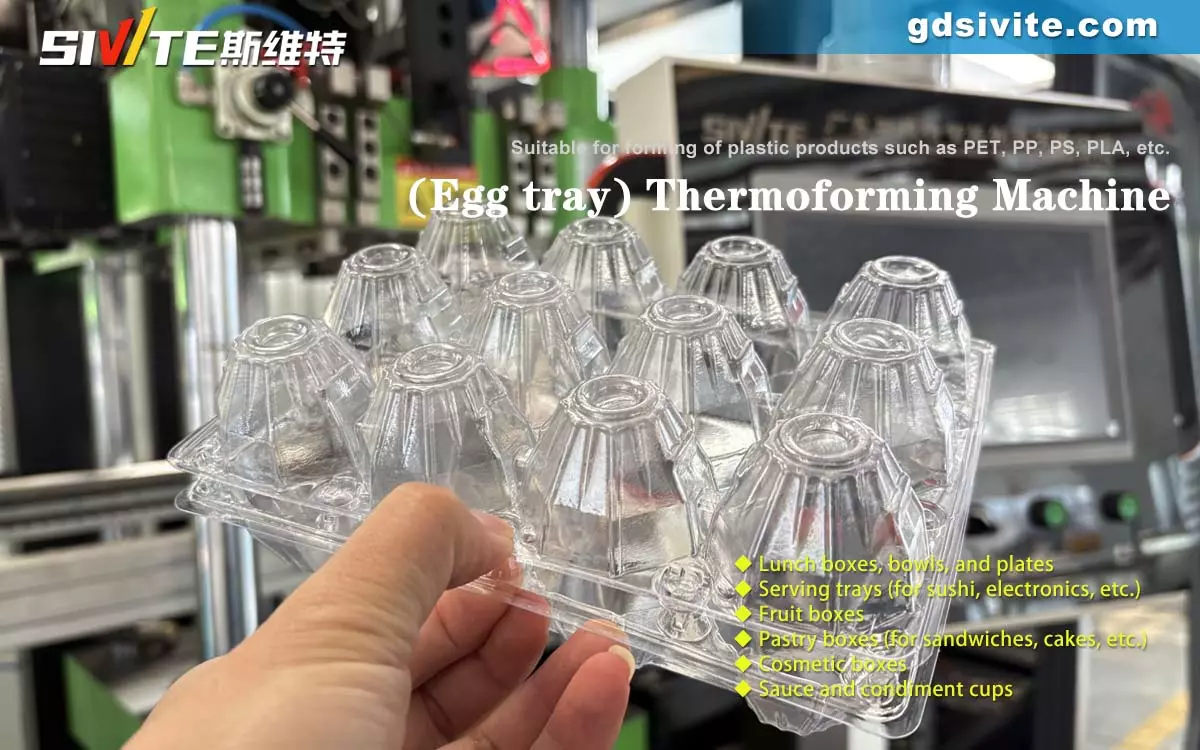
1.2 Process Optimization with SIVITE Thermoforming Machines
Traditional thermoforming production often relies on manual assistance, leading to inefficiency and potential quality issues due to operational errors. SIVITE thermoforming machines achieve full-process automation. Their intelligent control system can adapt to parameters for multiple specifications, and the transmission system.
2. Egg Tray Production Capacity and Influencing Factors
2.1 Egg Tray Production Capacity
The theoretical production capacity of egg trays is determined by equipment parameters and product specifications. According to the parameters of a standard thermoforming machine, the production capacity calculation for different egg tray specifications is as follows:
6-egg tray: 16 units/mold →320 units/min → 19,200 units/hour → 460,800 units/24 hours
10-egg tray: 8 units/mold → 160 units/min → 9,600 units/hour → 230,400 units/24 hours
20-egg tray: 4 units/mold → 80 units/min → 4,800 units/hour → 115,200 units/24 hours
Production changeover between different specifications only requires mold replacement, with the whole process taking just 8 minutes. This minimizes equipment downtime and ensures consistent production efficiency.
2.2 Influence of Equipment and Process Parameters
In addition to the machine model, the stability of the equipment and process parameters also directly impact production capacity. In terms of equipment, the stable operation of the heating, air pressure, and transmission systems is crucial for continuous production, as equipment failures can reduce effective production time. Regarding process parameters, precise coordination of heating temperature, forming pressure, and other variables is essential. Reasonable parameter settings can minimize rework, thereby indirectly enhancing production capacity.
III. Core Advantages of SIVITE Thermoforming Machines
3.1 Process Optimization Advantages
SIVITE thermoforming machines demonstrate remarkable advantages in optimizing the production process. They adopt a multi-station integrated design, which seamlessly connects all production links and eliminates the need for manual handling. Combined with an intelligent servo-driven transmission system, these machines significantly shorten the production cycle and improve process efficiency.
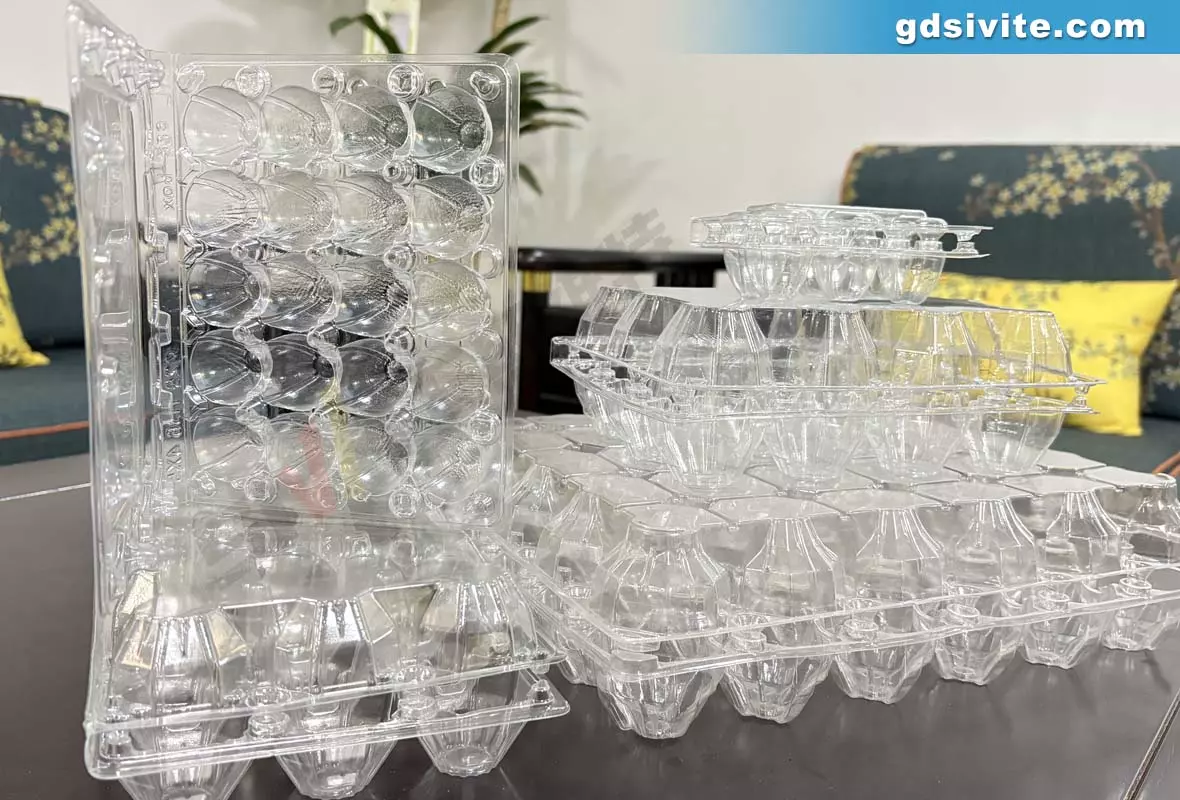
3.2 Production Capacity Improvement Advantages
SIVITE thermoforming machines feature two core advantages in boosting production capacity. First, they are equipped with a closed-loop temperature control system that can adjust temperature in real time, ensuring uniform heating of sheets and a forming qualification rate of over 99%. Second, the machines adopt a high-efficiency positive and negative pressure forming system, enabling fast and stable forming with a production output of 20–25 units per mold per minute. This supports 24-hour continuous production, further enhancing the capacity advantage.
IV. SIVITE – A Leading Manufacturer of High-Quality Egg Tray Thermoforming Machines
SIVITE thermoforming machines are a preferred choice, thanks to three core advantages: full-process automation, efficient positive/negative pressure forming, and precise temperature control. These strengths allow the equipment to handle multi-specification production needs, balance precision and efficiency, cut labor costs, and suit enterprises of all scales.
For businesses looking to enter egg tray production or upgrade equipment, choosing SIVITE means choosing stability and high efficiency. Contact the professional SIVITE team for customized one-on-one solutions and technical support to quickly achieve efficient, low-cost production.

Previous: What's the Best PET Hinge Box Production Machine for Mass Production?
Next: No More